Thank you for visiting our website.
A parish council is the first tier of local government and the elected collective voice of the community. Cromhall Parish Council has seven councillor positions. The council:
- has the power to raise a precept (a form of council tax),
- serves its local electorate
- gives the community a voice and representation and acts as an ambassador for Cromhall.
- works to improve community wellbeing.
- delivers a small number of services to meet local needs including grass cutting and bins, defibrillators bus shelters and notice boards.
- engages in planning issues as a consultee to South Gloucestershire Council.
- supports local groups that benefit Cromhall
- helps to improve and protect biodiversity in the parish.
Council meetings are meeting in public not public meetigns and are open to parish residents to attend. If you have something you’d like to raise, each meeting includes a period of public participation giving you the opportunity to speak directly to the Council about things that matter to you. The agendas and minutes of council meetings are posted on this website.
If there is anything you feel the Council should know about, or if you need support or guidance, please contact one of your Councillors or the Clerk.
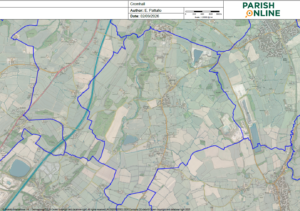
Map of the parish
Cromhall Parish Council is proud to have signed the Civility and Respect Pledge.
 |
 |
 |
Cromhall Parish
Cromhall parish sits in an ancient landscape. Slickstones Quarry (an SSSI) is an outstanding site for reptilian faunas and there is even a carnivorous dinosaur named after Cromhall, Agnosphitys cromhallensis. Farming dates back to Roman times. There is a long history of religious presence in the area with the story of the seventh century Cromhall hermit.
More recently evidence of the industrial lime and coal workings can be found in the numerous tumps or spoil tips dotted around the parish. Quarrying and agriculture remain to this day.
The name Cromhall is believed to originate from Anglo Saxon times combining two old English words, ‘crumbe’ meaning bent or crooked and ‘halh’ meaning a nook or corner of land where the early village was in a corner of land surrounded by Cromhall stream.
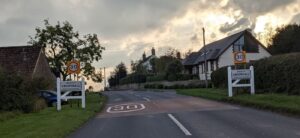
Cromhall, which includes Leyhill and many small hamlets, outlying homes and farms, is a small rural parish located in the north of South Gloucestershire, close to the Cotswold ANOB – the 2021 census shows 299 households although the overall population is recorded as higher as it includes residents at Leyhill Open Prison. The original village no longer exists and today the ‘village’ comprises a series of scattered hamlets with distinct names which predominately follows the line of the B4058 for just over a mile, making Cromhall one of the longest villages in the country:
Bibstone which may have originated from a combination of a person’s name and ‘tun’ or farmstead, Townwell, Longcross where the Bristol, Talbots End and Church Lane roads meet, Talbots End which contains some of the oldest buildings in Cromhall and Heathend where The Green (now a designated village green), may have been an early meeting place for travelling traders which developed from the eighteenth century onwards as the population increased and roads improved.
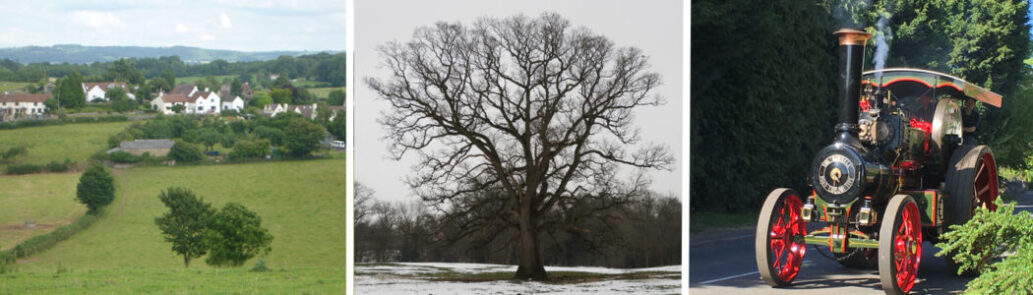
Images of Cromhall